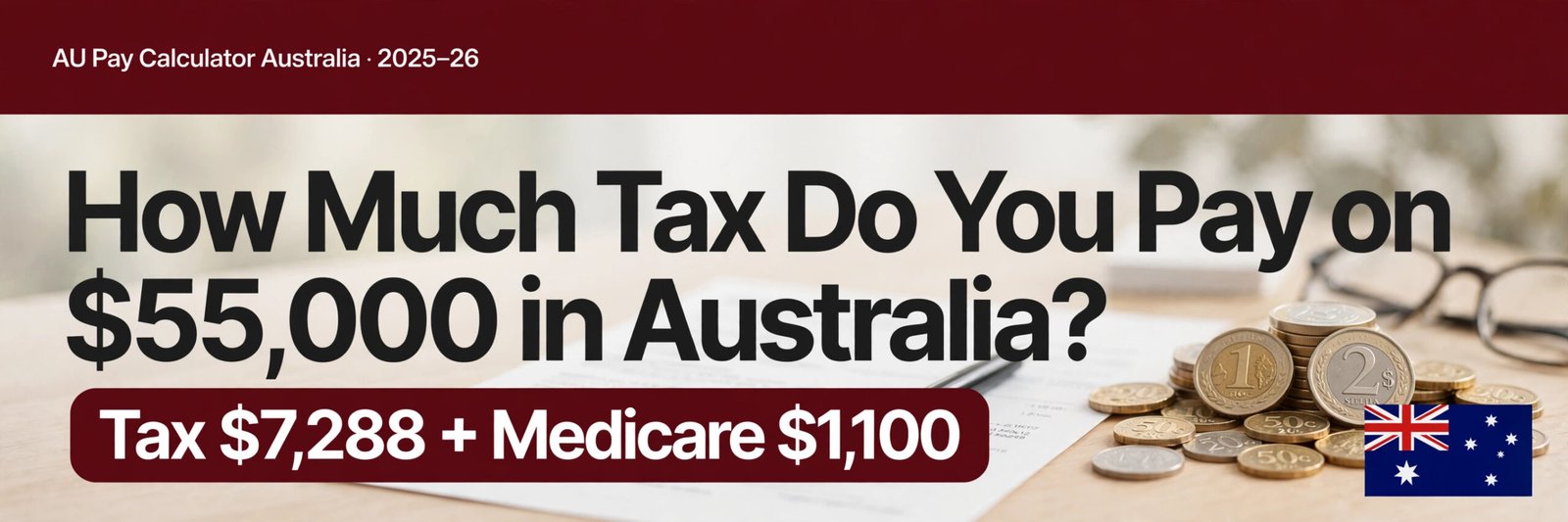
How much tax do you pay on $55,000 in Australia? In 2025–26, income tax on $55,000 is $7,288, and the 2% Medicare levy adds another $1,100. That is $8,388 in total deductions, leaving take-home pay of $46,612 a year, or about $896 a week. This guide shows exactly how that tax is calculated, what can change the result, and how $55,000 compares with other incomes.
To check your own income, use the income tax calculator or the $55,000 salary page.
The 2025–26 Tax Brackets
Australia taxes residents on a marginal scale: each slice of income is taxed at a different rate, and you only pay a higher rate on the income inside that bracket — never on your whole salary. The 2025–26 resident rates are: 0% on the first $18,200, 16% from $18,201 to $45,000, 30% from $45,001 to $135,000, 37% from $135,001 to $190,000, and 45% above $190,000. The 2% Medicare levy is calculated separately, on your full taxable income, subject to low-income thresholds.
| Taxable income | Rate |
|---|---|
| $0 – $18,200 | 0% |
| $18,201 – $45,000 | 16% |
| $45,001 – $135,000 | 30% |
| $135,001 – $190,000 | 37% |
| Over $190,000 | 45% |
Tax on $55,000, Step by Step
On $55,000, only two tax brackets are involved, plus the Medicare levy. Here is the full working:
- First $18,200: taxed at 0% — no tax payable. This is the tax-free threshold.
- $18,201 to $45,000 ($26,800): taxed at 16% — $4,288.
- $45,001 to $55,000 ($10,000): taxed at 30% — $3,000.
- Total income tax: $4,288 + $3,000 = $7,288.
- Medicare levy (2% of $55,000): $1,100.
- Total deductions: $8,388. Take-home pay: $46,612.
| Period | Gross | Tax + Medicare | Take-home |
|---|---|---|---|
| Weekly | $1,057.69 | $161.31 | $896.38 |
| Fortnightly | $2,115.38 | $322.62 | $1,792.77 |
| Monthly | $4,583.33 | $699.00 | $3,884.33 |
| Annual | $55,000 | $8,388 | $46,612 |
Your effective tax rate on $55,000 — total deductions divided by gross income — is 15.3%. Your marginal rate is 30% plus the 2% Medicare levy, or 32% on each extra dollar up to $135,000. That gap between the effective and marginal rates is normal: the tax-free threshold and the 16% bracket pull your average well below the rate on your last dollar. On top of your salary, your employer pays 12% superannuation guarantee contributions — $6,600 a year on $55,000 — into your super fund.
What Can Change Your Tax on $55,000
The figures above assume you are an Australian resident for tax purposes, you claim the tax-free threshold, you have no HECS-HELP debt, and you claim no deductions. Real payslips often differ, and the differences are worth understanding.
HECS-HELP repayments. If you have a student debt, compulsory repayments are withheld from your pay once your repayment income passes the minimum threshold, and they sit on top of income tax and Medicare. At $55,000, the repayment rate is low but not zero, so your take-home pay will be less than $46,612 until the debt is cleared. Your payment summary and myGov account show the balance and the amount withheld each year.
Deductions. Work-related expenses reduce your taxable income, which reduces your tax. If you claim $2,000 of deductions, your taxable income falls to $53,000 and your tax falls by about $600 (30% of $2,000, since deductions come off the top slice taxed at 30%). Common deductions at this income level include work-related car expenses, tools and equipment, uniforms with a logo, professional subscriptions, and self-education directly related to your current job. The work-from-home fixed rate method may also apply if you work from home.
Tax offsets. The Low Income Tax Offset (LITO) provides a maximum offset of $700, which phases out as income rises and is fully gone by $66,667. At $55,000 you still receive a partial offset, which the ATO applies automatically when you lodge your return — it is not reflected in the headline $7,288 figure, which is why your actual tax bill after lodging may be lower than the withholding calculation suggests. The Low and Middle Income Tax Offset (LMITO) is no longer available; it ended after the 2021–22 income year, so do not expect it.
Medicare levy reduction. Low-income earners may qualify for a reduced Medicare levy or an exemption. At $55,000 for a single person without dependants, the full 2% levy generally applies, but thresholds are higher for families, seniors and pensioners, so check your circumstances if any of those apply.
Second jobs and extra income. If you earn $55,000 across two jobs, only one employer should apply the tax-free threshold. If both do, too little tax is withheld during the year and you will face a bill at tax time. The same applies to side income from freelancing or gig work, which must be declared and is taxed at your marginal rate.
Comparing $55,000 With Nearby Incomes
| Gross income | Income tax | Medicare levy | Take-home | Effective rate |
|---|---|---|---|---|
| $45,000 | $4,288 | $900 | $39,812 | 11.5% |
| $50,000 | $5,788 | $1,000 | $43,212 | 13.6% |
| $55,000 | $7,288 | $1,100 | $46,612 | 15.3% |
| $60,000 | $8,788 | $1,200 | $50,012 | 16.6% |
| $65,000 | $10,288 | $1,300 | $53,412 | 17.8% |
Each extra $5,000 of gross pay in this range adds about $3,400 to take-home pay, because the marginal rate is 32%. A pay rise from $55,000 to $60,000, for example, puts an extra $3,400 in your pocket — worth having, and a useful reality check when weighing a promotion that comes with more hours or responsibility.
For context, $55,000 is just above the full-time minimum wage of about $52,255 a year (at $26.44 an hour from 1 July 2026), and well below the average full-time wage of around $104,520 (ABS, May 2025). It is a common salary for part-time workers moving to full-time hours, early-career roles, and many retail, hospitality, administration and community-service positions.
Making $55,000 Work: Budgeting on $896 a Week
Take-home pay of $896 a week — $3,884 a month — requires a disciplined budget, but it is workable for a single person in most of Australia. A realistic monthly split might be: $1,200–$1,600 for rent (a room in a share house or a modest unit outside inner-city areas), $500–$650 for groceries and household essentials, $200–$400 for transport, and $200–$300 for utilities, phone and internet. That leaves roughly $800–$1,500 for everything else, including savings, clothing, entertainment and debt repayment. The two costs that most often break a budget at this income are car costs — repayments, fuel, insurance and registration can easily exceed $500 a month — and credit card interest, which at typical rates can swallow hundreds of dollars a month if a balance is carried. Paying down high-interest debt is usually the highest-return financial move available at this income level, beating any savings account or investment return. If you receive a tax refund each year, consider treating it as a windfall for debt repayment or an emergency fund rather than absorbing it into everyday spending.
Government support can also make a real difference at $55,000. Rent assistance is available to eligible renters receiving certain income support payments, and family payments assist households with children. Concession cards may reduce the cost of medicines, transport and utilities depending on your state and circumstances. These payments are not reflected in the $46,612 take-home figure, so your effective household income may be higher than the salary calculation alone suggests.
Frequently Asked Questions
How much tax do I pay on $55,000 in Australia?
In 2025–26, income tax on $55,000 is $7,288. With the 2% Medicare levy ($1,100), total deductions are $8,388, leaving take-home pay of $46,612 a year.
What is the tax rate on $55,000?
Your tax is marginal: 0% on the first $18,200, 16% to $45,000, and 30% on the $10,000 above $45,000. Your effective rate including Medicare is 15.3%.
Why is my take-home pay less than $896 a week?
The most common reasons are HECS-HELP repayments, salary sacrifice deductions, or not claiming the tax-free threshold with your main employer. Check your payslip for separate line items beyond income tax and Medicare.
Do I get a tax refund on $55,000?
Possibly. If you claim deductions or receive a partial Low Income Tax Offset, your final tax bill after lodging may be lower than the tax withheld during the year, producing a refund. Over-withholding and HECS overpayments can also produce refunds.
How much super do I get on $55,000?
Your employer pays 12% superannuation guarantee contributions, which is $6,600 a year on $55,000, on top of your salary.
What is $55,000 an hour?
On a standard 38-hour week, $55,000 equals about $27.83 an hour gross, or about $23.59 an hour after tax and the Medicare levy.
Conclusion: Tax on $55,000 at a Glance
Tax on $55,000 in 2025–26 is $7,288 in income tax plus $1,100 in Medicare levy — $8,388 in total — leaving $46,612 take-home, or $896 a week. Your effective rate is 15.3%, while your marginal rate is 32%, so each extra dollar you earn keeps about 68 cents. HECS repayments, deductions and the Low Income Tax Offset are the three things most likely to move your final figure, so check them before assuming the headline number is your exact pay. To model your own situation, use the income tax calculator or the $55,000 salary page.