
Every employee, freelancer and job-seeker in Australia needs to know their actual take-home pay because a gross figure alone isn’t enough. The Salary Calculator Australia is built exactly for this: you enter your gross salary and the tool estimates how much money you’re left with after tax, Medicare levy and superannuation. Whether you’re searching for a pay calculator Australia, wage calculator Australia, or simply an Australian salary calculator, this tool is designed to answer the same core question: what will actually land in your bank account.
The calculator doesn’t just give you one number; it also converts your salary into different pay periods (annually, monthly, fortnightly, weekly, daily, hourly) so you can understand your income from every angle. You can also select options based on your situation, like a HECS-HELP debt, a Medicare exemption or a super arrangement and these directly affect your final result.
In this guide, we explain each field option and result of the calculator step by step, so you can confidently calculate your take-home pay.
Salary Calculator Australia
Click Here: Australian Salary Calculator
Enter your salary and select the options that apply to you. The calculator then estimates your gross salary, income tax, take-home pay, deductions and equivalent pay amounts for different periods. This is the same tool many users look for as an Aus salary calculator, built specifically around Australian tax, Medicare levy and superannuation rules.
How to Use the Salary Calculator
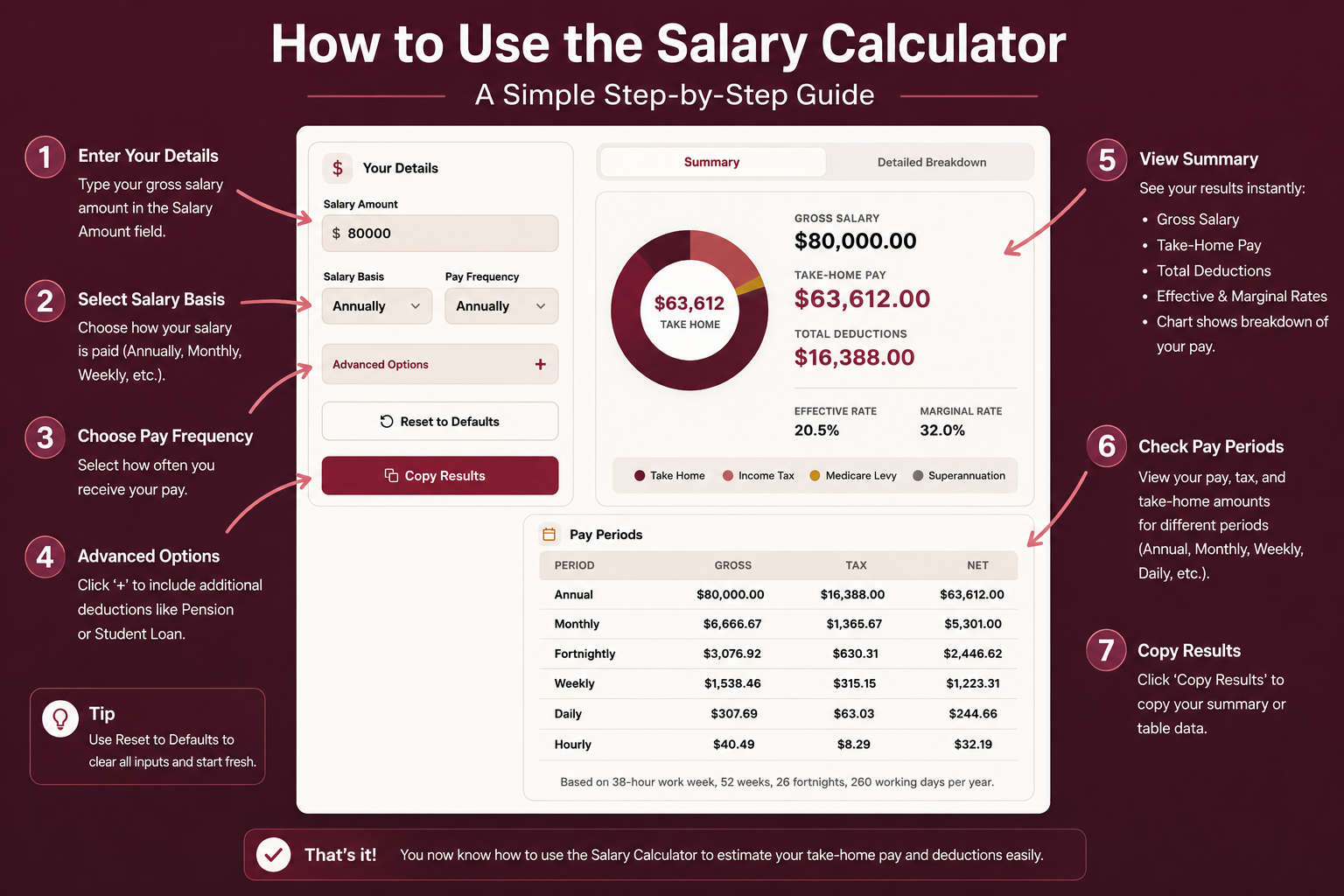
Follow the steps below to understand what each field in the calculator means and how it affects your estimated results.
Why Use the Salary Calculator Australia? (Benefits & Importance)
Your contract shows gross salary. Your bank account shows net pay. The gap between them is income tax, Medicare levy and sometimes a student loan repayment, and guessing it is how budgets fall apart. Here’s why the calculator is worth using:
1. You see your real take-home pay
Gross salary tells you what you earn. Take-home pay tells you what you can spend. The calculator shows what’s left after income tax and Medicare levy, so you can plan around the amount that actually reaches your account.
2. You can compare job offers fairly
Package wording changes the real number. $80,000 plus super and $90,000 inclusive of super look far apart, but the cash salary is almost the same (about $80,000 vs $80,357). The Super on top and Super inclusive options show this in seconds.
3. Budgeting gets easier.
Rent, bills and groceries don’t arrive as annual figures. Converting your pay into monthly, fortnightly, weekly or hourly amounts lets you match income to how your expenses actually come in.
4. You understand your superannuation.
Super is part of your total package, but you don’t receive it as cash now. Seeing it separated from your take-home pay shows what you’re building for retirement and what your employer really pays for you.
5. You can plan for HECS-HELP or VETSL repayments.
Study loan repayments reduce your pay. Including them in the estimate shows the true impact before it appears on your payslip.
6. It helps with salary negotiation and career decisions.
Australia’s tax system is progressive, so extra income is taxed at your marginal rate, not your average rate. Checking how a raise, a second income or a job change affects your net pay tells you whether it’s worth it.
7. It saves time and reduces mistakes.
Working out tax brackets, Medicare levy, super and study loan repayments by hand is slow and easy to get wrong. One entry gives you every figure at once.
The result is an estimate, but a solid starting point for deciding on an offer, planning a move or setting a budget.
Salary Calculator Options Explained
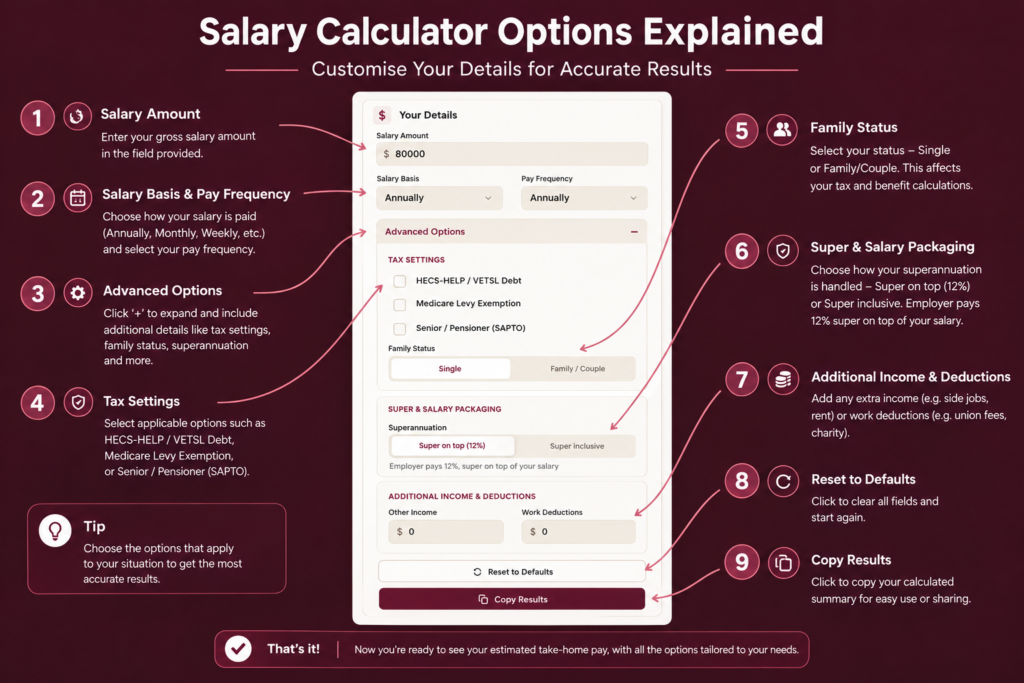
Salary Amount
Enter your gross salary (the amount before tax and other deductions are taken out). In the Salary Amount field, enter the amount for whichever period you’re paid in (annually, monthly, weekly, etc.). The period is set by the Salary Basis field.
Example: If your annual salary is $80,000, enter $80,000 in the Salary Amount field.
Salary Basis
Salary Basis tells the calculator the time period for the amount you entered.
- Annually
- Monthly
- Fortnightly
- Weekly
- Daily
- Hourly
This field can be confusing, so it’s important to understand it.
Salary Basis means whether your salary is hourly, weekly, monthly or yearly.
Example: If you earn $1,538.46 per week, select Weekly rather than Annually.
If you enter a weekly amount but select Annually, the calculator will give incorrect results. Make sure you choose the correct salary basis first.
Depending on how you’re paid, you might specifically be looking for an annual salary calculator, monthly salary calculator, fortnightly salary calculator, weekly salary calculator or even an hourly rate and salary calculator. The Salary Basis field lets one tool handle all of these instead of needing a separate calculator for each pay period.
Pay Frequency
Pay Frequency tells the calculator when you receive your pay, regardless of your Salary Basis:
- Annually
- Monthly
- Fortnightly
- Weekly
Pay Frequency = your payment schedule
Example: Someone has an annual salary of $80,000 but receives their salary fortnightly.
So Salary Basis and Pay Frequency each serve a different purpose: one defines the period the amount is for the other defines how often you’re actually paid.
Tax Settings
| Option | What it means |
| HECS-HELP / VETSL Debt | Study/training loan repayment settings |
| Medicare Levy Exemption | Used where the user qualifies for an exemption |
| Senior / Pensioner (SAPTO) | Applies to eligible seniors/pensioners |
| Family Status | Select Single or Family/Couple where applicable |
HECS-HELP or VETSL Study Loan: If you have a HECS-HELP or VETSL study loan, select this option. The calculator will include your compulsory repayment based on your repayment income.
Visit Now: Study and training loan repayment thresholds and rates
Study and Training Loan Repayments: These repayments follow Australian tax rules and are based on your repayment income. The ATO uses specific income thresholds and repayment rates to calculate the compulsory amount.
Medicare Levy Exemption: Select this option only if you officially qualify for a Medicare levy exemption. If you are unsure, leave it unchecked and check the ATO’s Medicare levy guidance.
Visit Now: Medicare levy
Together, these settings let the tool work like a full salary calculator with tax built in, similar to a payslip calculator that breaks down exactly where each dollar of your pay goes.
Superannuation
There are two options in the Superannuation section:
Super on top: Your employer pays super in addition to your salary. The calculator uses the selected super rate to run the calculation.
Super inclusive: Your salary package already includes super. In this case, the super component is treated separately when working out your cash salary.
Australia’s superannuation guarantee rate is currently 12%, effective from 1 July 2025, the final step in a series of legislated increases. This is why the calculator uses this rate by default. This function is sometimes searched for as a salary packaging calculator or a salary inclusive of superannuation calculator, since it separates your super entitlement from your cash-in-hand salary the same way an employer’s salary package would.
Additional Income & Deductions
Other Income: If you have any taxable income besides your salary, enter it here. This amount affects your overall estimate since Australia’s tax system is progressive.
Example: If you earn $80,000 from employment and have another $5,000 of relevant income, enter $5,000 under Other Income.
Work Deductions: Enter only the work-related deductions you are eligible to claim. Don’t use a random or estimated amount, as this can give you an inaccurate result. Check the ATO’s guidance on work-related deductions if you’re unsure about what you can claim.
Visit Now: Work-related deductions
Understanding Your Salary Calculator Results
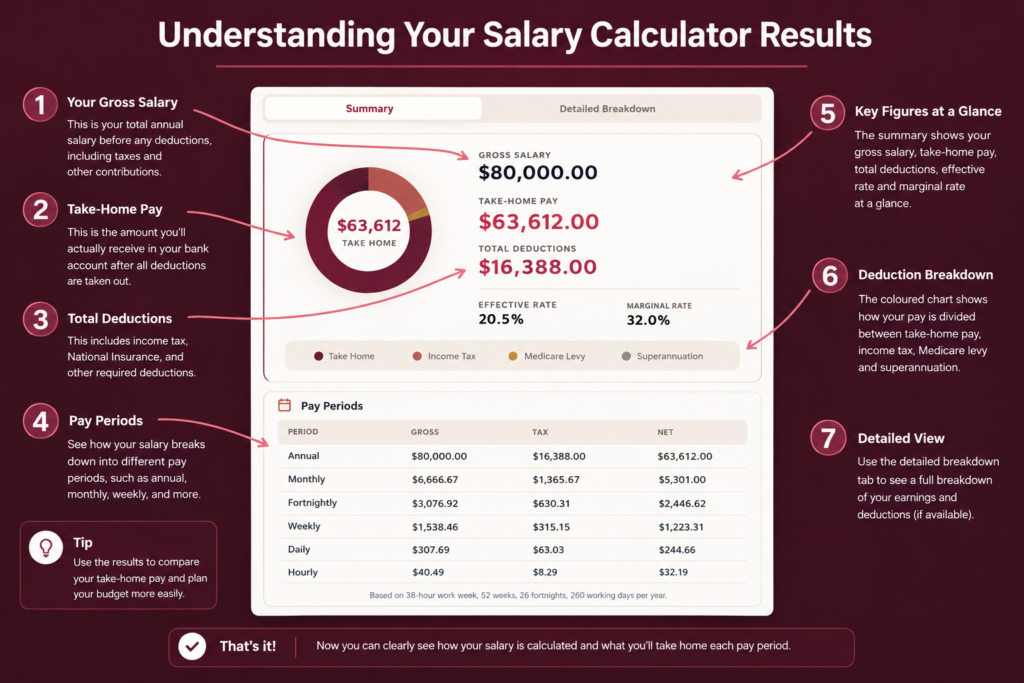
Gross Salary
Gross Salary is your income before tax and other deductions.
Example: Gross Salary: $80,000
Converting this figure into your final pay is the same job a gross salary to net salary calculator or a salary calculator gross to net performs, starting from your gross figure and working down to what you actually receive.
Take-Home Pay
Take-home pay is what you have left after the calculator’s deductions. Keep in mind that your actual payslip may be slightly different because of your tax situation, payroll setup and other factors. This is the core function of any take-home pay calculator or take-home salary calculator in Australia.
Total Deductions
Total Deductions can include:
- Income tax
- Medicare levy
- Superannuation (where relevant)
- Other applicable settings/deductions
Effective Rate
The effective rate shows how much of your gross income goes to tax and deductions. This is different from your marginal tax rate.
Marginal Rate
The marginal tax rate is the tax rate applied to any additional income you earn, not to your entire salary.
For example, the second resident tax bracket changes from 16% to 15% from 1 July 2026. This rate applies to income between $18,201 and $45,000. You can check the official ATO tax tables to find your tax bracket.
Visit Now: Tax rates – Australian resident
Understanding the Salary Breakdown Chart
The chart gives you a visual breakdown of where your salary goes.
- Take Home
- Income Tax
- Medicare Levy
- Superannuation
It shows how your income is divided between take-home pay, tax, Medicare levy and superannuation.
$80,000 Salary Conversion Example
| Pay Period | Gross | Tax | Net |
| Annual | $80,000.00 | $16,388.00 | $63,612.00 |
| Monthly | $6,666.67 | $1,365.67 | $5,301.00 |
| Fortnightly | $3,076.92 | $630.31 | $2,446.62 |
| Weekly | $1,538.46 | $315.15 | $1,223.31 |
| Daily | $307.69 | $63.03 | $244.66 |
| Hourly | $40.49 | $8.29 | $32.19 |
This example uses 52 weeks, 26 fortnights and 260 working days per year, based on a 38-hour working week. This kind of pay-period breakdown is exactly what a yearly salary calculator or weekly pay calculator is used for turning one annual figure into every other period at once.
$80,000 a Year Is How Much a Month?
Dividing $80,000 by 12 gives a monthly gross of $6,666.67, with an estimated net of roughly $5,301.00 a month after taxes and deductions.
$80,000 a Year Is How Much a Week?
Every week, an $80,000 annual salary works out to $1,538.46 gross per week, with an estimated net of roughly $1,223.31 a week.
$80,000 a Year Is How Much an Hour?
Based on a 38-hour working week, an $80,000 annual salary works out to roughly $40.49 gross per hour, with an estimated net of roughly $32.19 an hour.
Common Salary Conversions
| Annual Salary | Income Tax | Medicare (2%) | Total Tax | Net Annual | Net Monthly | Net Weekly | Net Hourly |
| $50,000 | $5,270 | $1,000 | $6,270 | $43,730 | $3,644.17 | $840.96 | $22.13 |
| $60,000 | $8,420 | $1,200 | $9,620 | $50,380 | $4,198.33 | $968.85 | $25.50 |
| $70,000 | $11,520 | $1,400 | $12,920 | $57,080 | $4,756.67 | $1,097.69 | $28.89 |
| $80,000 | $14,520 | $1,600 | $16,388 | $63,880 | $5,323.33 | $1,228.46 | $32.33 |
| $90,000 | $17,520 | $1,800 | $19,320 | $70,680 | $5,890.00 | $1,359.23 | $35.77 |
| $100,000 | $20,520 | $2,000 | $22,520 | $77,480 | $6,456.67 | $1,490.00 | $39.21 |
| $120,000 | $26,520 | $2,400 | $28,920 | $91,080 | $7,590.00 | $1,751.54 | $46.09 |
| $150,000 | $36,570 | $3,000 | $39,570 | $110,430 | $9,202.50 | $2,123.65 | $55.89 |
How the Salary Calculator Works
The calculator’s basic calculation flow works like this:
- Enter your salary
- Choose the pay period
- Apply your tax and deduction settings
- Calculate your take-home pay
- See your pay for each period
For example, if you enter your annual salary, the calculator can show the equivalent monthly, fortnightly, weekly, daily and hourly amounts based on its calculation settings. Because it covers annual, monthly, fortnightly, weekly, daily and hourly pay in one place, many people simply refer to this as an all-in-one wage calculator Australia or paycheck calculator.
Keep in mind: the calculator provides an estimate. Your actual payslip can differ because payroll withholding, tax residency, study loan obligations, deductions, super arrangements and other individual circumstances may affect the final amount.
What is considered a good salary in Australia?
A salary above the national average is generally seen as good. Full-time average earnings sit around $108,000 a year (ABS AWOTE), while median earnings are closer to $75,000. Earnings above $90,000–$100,000 are typically viewed as a high income, though it varies by state, industry and household size.
What is the average take-home pay in Australia?
Average full-time earnings (~$108,350 a year) work out to roughly $83,160 net annually, or about $1,599 a week after tax and the Medicare levy (FY2026-27 rates).
What is the average salary in Australia in 2026?
Full-time adult average earnings (AWOTE) were $2,083.70 a week in May 2026, about $108,350 a year (ABS). This average is pulled up by high earners; ABS median weekly earnings for all employees sit closer to $1,436, or roughly $74,670 a year.
What is the minimum wage in Australia?
The National Minimum Wage is $26.44 an hour, or $1,004.90 a week (38-hour week), effective from 1 July 2026. Casual employees receive at least $33.05 an hour, including the 25% casual loading.
Is $50,000 a good salary in Australia?
$50,000 is below both the average (~$108,000) and median (~$75,000). It takes home about $43,730 a year (~$841 a week), modest for a single person in a capital city, but more workable in lower-cost regions.
Is $70,000 (70,000 AUD) a good salary in Australia?
$70,000 sits close to the median full-time earnings and takes home about $57,080 a year (~$1,098 a week), a reasonable, middle-of-the-pack income, comfortable in regional areas.
Is $80,000 a good wage in Australia?
$80,000 is above the median and takes home about $63,880 a year (~$1,228 a week), generally a solid, above-average income for a single earner.
Is $100,000 a good wage in Australia?
$100,000 is close to average full-time earnings, taking home about $77,480 a year (~$1,490 a week), widely seen as a high income.
Is $2,000 a week after tax good in Australia?
$2,000 net a week is about $104,000 a year take-home, well above what the average gross salary (~$108,000) nets (~$1,599/week). Reaching $2,000/week after tax needs a gross salary of roughly $140,000, so yes, this is a high, well-above-average income.
What salary range are you seeking, inclusive of superannuation?
This job-application question asks for your total expected package with the 12% superannuation guarantee already included, not paid on top. E.g., $90,000 inclusive of super breaks down to about $80,357 base salary + $9,643 super. Use the calculator’s “Super inclusive” option to convert between the two.
What does “plus super” mean when describing a salary?
“Plus super” means the quoted figure is your base cash salary, and your employer pays the 12% super guarantee on top of it. E.g. $80,000 plus super = $80,000 cash + $9,600 super = $89,600 total employer cost. Use the calculator’s “Super on top” option for this.
Conclusion
The Salary Calculator Australia helps you to understand your exact financial position. Just enter your gross salary, choose your salary basis, pay frequency, add any applicable tax settings, super arrangement, deductions and instantly see your estimated take-home pay. You can also compare conversions across different pay periods.
Ready to estimate your Australian take-home pay? Enter your salary above and use the calculator to see your estimated tax, deductions and pay-period amounts. Whether you search for it as a pay calculator Australia or a wage calculator Australia, you can calculate take-home pay accurately in just a few seconds.