Public holidays are the best-paid days on the Australian calendar. Work on one and you’ll typically earn two and a half times your ordinary rate; don’t work and most employees still get paid their normal day’s wage. But the rules have sharp edges — casual rates differ, minimum shift lengths apply, and not every “holiday” counts.
This guide covers how public holiday pay rates work in Australia, who gets paid what, and the common traps. To estimate your own public holiday earnings, use the shift penalty calculator.
The 250% Rule: What Working a Public Holiday Pays
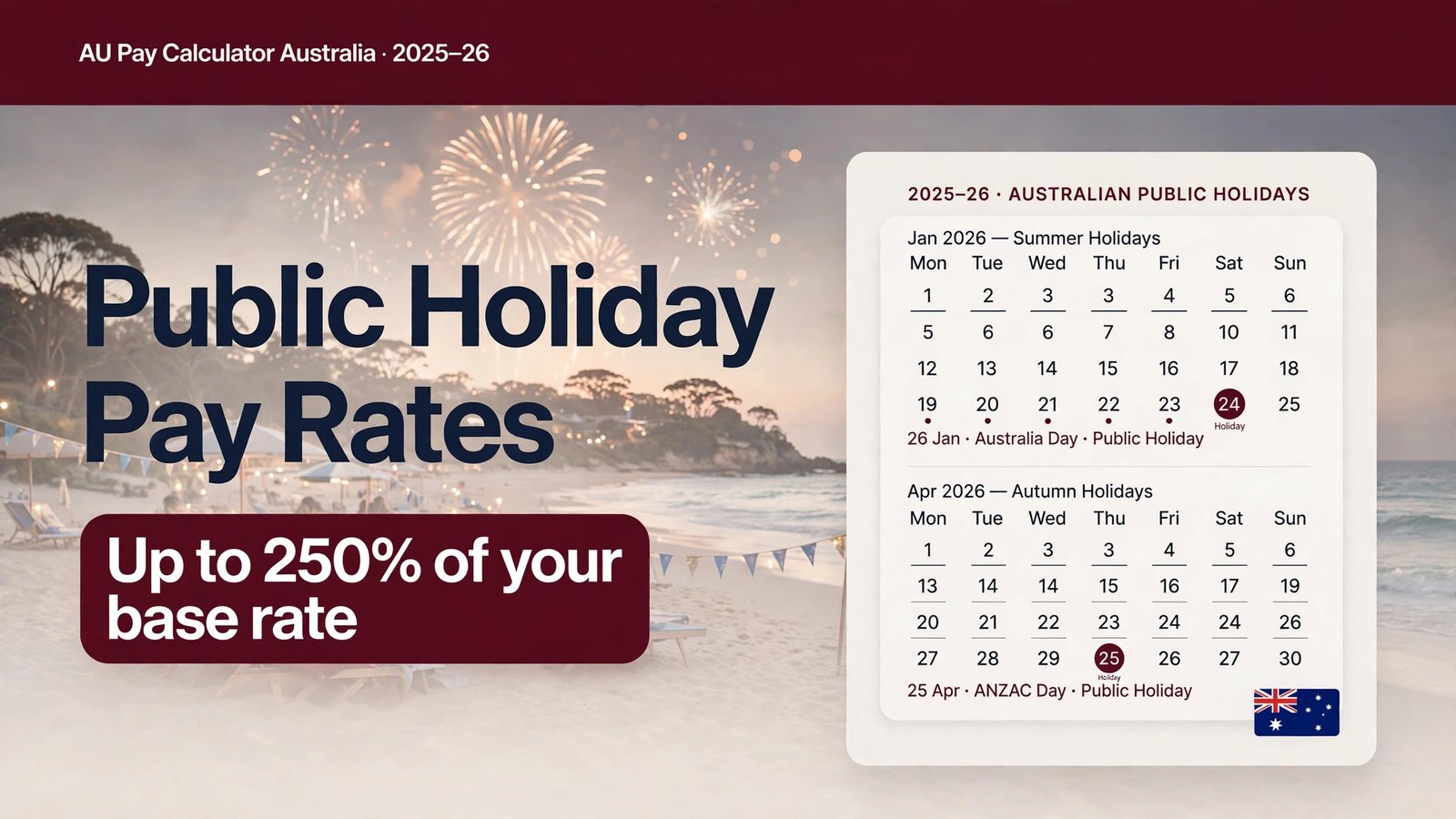
Under most modern awards — including retail, hospitality, fast food and restaurants — an employee who works on a public holiday is paid 250% of their base rate (double time and a half) for all hours worked. That’s the single highest standard penalty rate in the Australian system.
Some awards go further for particular arrangements:
- SCHADS Award (social, community, home care and disability services): 250% for permanent employees, 275% for casuals on public holidays
- Health and aged care awards: typically 250%, with some classifications higher
- Retail Award casuals: 250% inclusive of the 25% casual loading — the published casual public-holiday rate already contains the loading, so don’t add it again
Because public holiday rates are so high, they always beat weekend or evening penalties for the same hours — and as with other penalties, the higher rate wins rather than stacking.
Not Working? You’re Usually Still Paid
Under the National Employment Standards (NES), a full-time or part-time employee who would ordinarily have worked on the public holiday is entitled to be absent without loss of pay — in other words, paid their normal rate for the hours they would have worked.
Key points:
- The payment is at your base rate for the ordinary hours you would have worked — no penalties, no loading
- If the public holiday falls on a day you weren’t rostered to work, there’s generally no extra payment (some awards and agreements differ)
- Casuals have no entitlement to be paid for public holidays they don’t work — no work, no pay is the casual trade-off
This is why the “not working” outcome matters most to permanent part-timers: a part-timer rostered every Monday gets paid for Anzac Day or the King’s Birthday when they fall on a Monday, but not for holidays on other weekdays.
Minimum Engagement: The 4-Hour Rule
Many awards require a minimum payment for public holiday work — commonly 4 hours at the public holiday rate, even if you work less. Come in for a 2-hour emergency shift on Christmas Day under such an award and you’re paid for 4 hours at 250%.
This minimum engagement is one of the most commonly underpaid entitlements, because payroll systems sometimes log only actual hours. If you worked a short public holiday shift, check your payslip against the 4-hour minimum in your award.
Which Days Count? National Public Holidays
The NES recognises these public holidays across Australia:
| Public holiday | Date |
|---|---|
| New Year’s Day | 1 January |
| Australia Day | 26 January |
| Good Friday | Varies (March/April) |
| Easter Saturday | Day after Good Friday |
| Easter Sunday | Varies |
| Easter Monday | Varies |
| Anzac Day | 25 April |
| King’s Birthday | Varies by state/territory |
| Christmas Day | 25 December |
| Boxing Day | 26 December |
States and territories add their own holidays (Labour Day, state-specific show days, and in some states additional days), and when a holiday falls on a weekend, substitute or additional days are usually declared — for example, when Christmas Day falls on a Saturday, an extra public holiday is typically declared on the following Monday. Your award or the Fair Work Ombudsman’s public holidays page confirms which days count in your state.
Can You Refuse to Work a Public Holiday?
Yes — with limits. The NES gives both sides rights: an employer can request you to work on a public holiday, and you can refuse the request if the refusal is reasonable (or if the request itself is unreasonable). What’s “reasonable” depends on factors like the nature of your workplace, your role, your personal circumstances, and how much notice you were given.
In practice, in industries like hospitality and healthcare where public holiday work is normal, refusing is harder to justify — but the right exists, and an employer can’t punish you for a reasonable refusal.
Worked Example: Christmas Day Shift
Take Sam, a permanent retail worker on a $30 base rate, working 6 hours on Christmas Day:
- Public holiday rate: $30 × 2.5 × 6 = $450
- Compared to an ordinary weekday: $30 × 6 = $180
- The public holiday adds $270 — one and a half extra days’ pay for a single shift
Now compare a casual colleague on the same $30 base: the Retail Award’s casual public-holiday rate is 250% inclusive of loading, so the casual also earns $450 for the 6 hours — the loading is already inside the 250% figure. Under the SCHADS Award, a casual would instead get 275%: $30 × 2.75 × 6 = $495.
Substitute Days and Part-Day Public Holidays
When a public holiday falls on a weekend, you don’t simply lose it. States and territories usually declare a substitute or additional public holiday — most commonly, when Christmas Day or Boxing Day falls on a Saturday or Sunday, an extra public holiday is declared on the following Monday (and sometimes Tuesday). The substitute day carries the full public holiday entitlements: 250% if you work, paid absence if you were rostered.
Some states also declare part-day public holidays: in Queensland, South Australia, the Northern Territory and the ACT, Christmas Eve and New Year’s Eve are public holidays from 7pm to midnight. Work during those evening hours attracts public holiday rates; work earlier in the day is paid normally. These are easy to miss on a payslip, so check the evening portion of your Christmas Eve and New Year’s Eve shifts.
Public Holidays During Annual Leave or Sick Leave
A useful rule many workers don’t know: if a public holiday falls during a period of paid annual leave, you’re taken to be on the public holiday for that day — not on annual leave. The day isn’t deducted from your leave balance; you’re simply paid the public holiday rate for it instead.
The same principle applies to paid sick leave and other forms of paid leave in most awards: the public holiday takes precedence. So if you’re on a two-week beach holiday and Anzac Day falls in the middle, you effectively get that day of annual leave back. Check your payslip after returning from leave that included a public holiday — payroll systems don’t always apply this automatically.
What Counts as the “Base Rate”?
The 250% multiplier applies to your ordinary hourly base rate — the rate for your classification under the award, before any loadings or allowances. It does not include overtime rates, and for casuals the published rate usually already includes the 25% casual loading. Allowances (like a first-aid allowance or uniform allowance) are generally paid separately and aren’t multiplied — though a few awards do fold certain all-purpose allowances into the base before applying penalties, so check your award’s definitions clause if an allowance makes up a big part of your pay.
Frequently Asked Questions
What is the public holiday pay rate in Australia?
Typically 250% (double time and a half) of the base rate for all hours worked, under most modern awards. Some awards pay casuals more — e.g. 275% under the SCHADS Award — and some awards’ casual rates are inclusive of the 25% casual loading.
Do casuals get paid for public holidays they don’t work?
No. Casuals are only paid for hours actually worked on a public holiday, at the public holiday rate. The NES entitlement to be absent without loss of pay applies to full-time and part-time employees only.
Do I get paid if a public holiday falls on my day off?
Generally no extra payment if you weren’t rostered to work — though some awards and enterprise agreements provide a substitute day or extra pay, so check your instrument.
What is the minimum shift length on a public holiday?
Many awards require a minimum 4-hour payment at the public holiday rate, even for shorter shifts. Check your award’s public holidays clause.
Are public holiday penalty rates on top of weekend rates?
No — the public holiday rate replaces the weekend rate. You get the higher of the applicable rates, not both stacked together.
Does superannuation apply to public holiday pay?
Yes, for ordinary hours worked on the public holiday — public holiday penalty payments for ordinary hours attract the 12% superannuation guarantee.
Conclusion
Public holidays are the most lucrative days in the Australian pay system: 250% for working them under most awards, a paid day off at base rates for permanent staff who don’t, and minimum engagement rules that protect short shifts. The main traps are casual loading double-counting and missed minimum payments — both worth checking on every public-holiday payslip.
Estimate your own public holiday earnings with the shift penalty calculator.