On 1 June 2026, every Australian with a student loan balance older than 11 months saw it grow — automatically, with no bill and no warning letter. That’s HECS indexation: the annual adjustment that keeps student debt in line with inflation. The good news? The 2026 rate was 2.8%, the lowest since 2021. The bad news? On an average debt, it still added hundreds of dollars.
This guide breaks down exactly what the 2026 indexation did to typical balances, how it compares with recent years, how it interacts with the 20% debt cut, and what you can do before the next indexation on 1 June 2027. To see how indexation affects your own repayment timeline, try our HECS calculator.
What Is HECS Indexation?
HECS-HELP debt doesn’t charge interest like a bank loan — but it isn’t frozen either. Each year on 1 June, the Australian Taxation Office applies indexation to the part of your HELP debt that has been unpaid for more than 11 months. Indexation adjusts the debt to reflect changes in the cost of living, so the real value of the loan is maintained over time.
Since reforms passed in 2024 (backdated to June 2023), the indexation rate is set at the lower of the Consumer Price Index (CPI) or the Wage Price Index (WPI). The cap was introduced after the record 7.1% indexation of 2023 sparked a political backlash — it ensures your debt can never grow faster than wages are growing.
Indexation applies to all study and training loans: HECS-HELP, FEE-HELP, SA-HELP, OS-HELP, VET Student Loans, Student Start-up Loans and Australian Apprenticeship Support Loans.
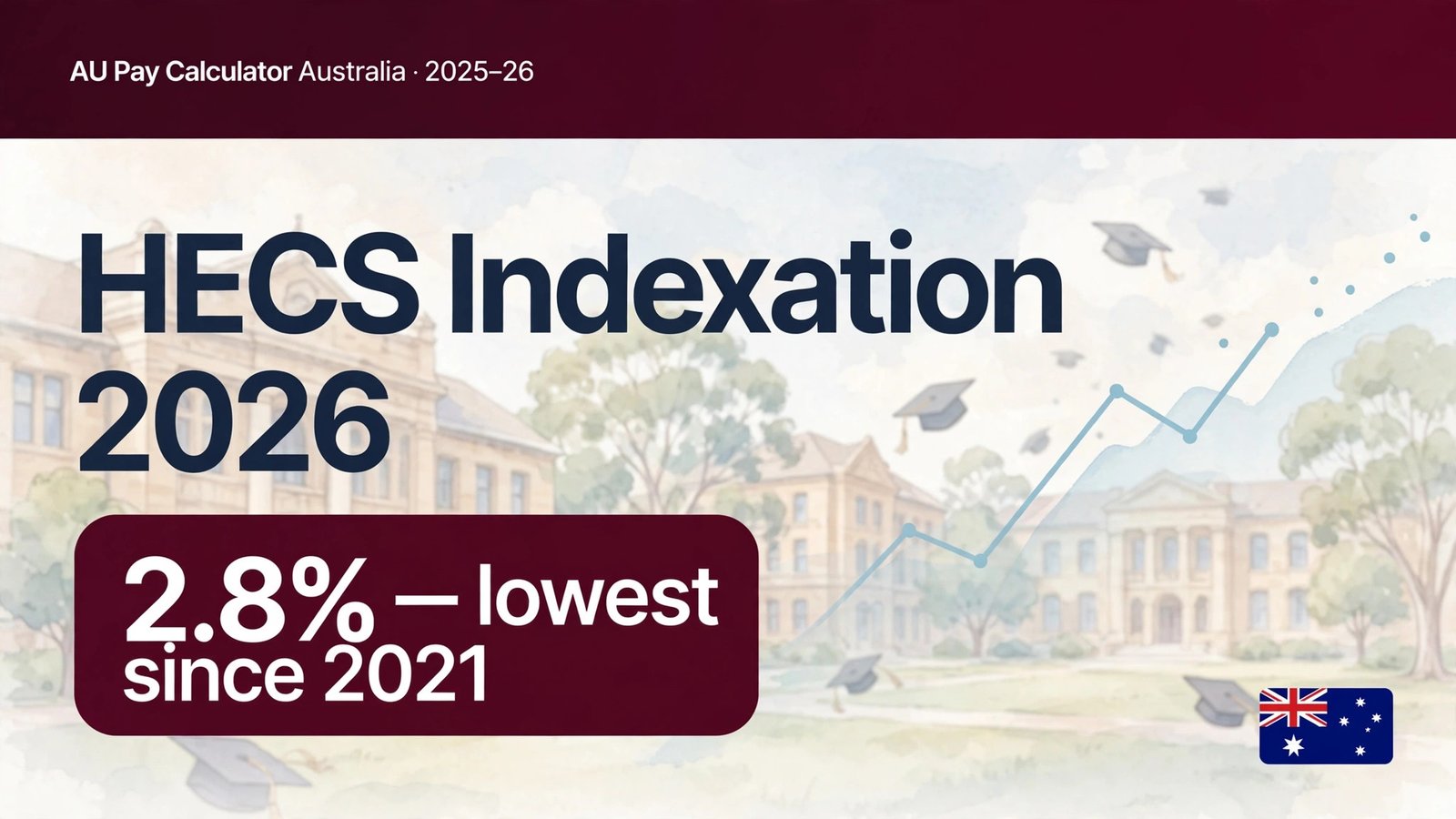
The 2026 Rate: 2.8% — Lowest Since 2021
The official 2026 indexation rate, announced by the government in May 2026, was 2.8% — the lowest rate since 2021 and a long way down from the 7.1% shock of 2023. Here’s what it added to typical balances:
| HELP balance before 1 June 2026 | Indexation at 2.8% | New balance |
|---|---|---|
| $15,000 | $420 | $15,420 |
| $26,494 (average loan) | $742 | $27,236 |
| $40,000 | $1,120 | $41,120 |
| $60,000 | $1,680 | $61,680 |
| $80,000 | $2,240 | $82,240 |
| $104,000 (maximum HELP balance) | $2,912 | $106,912 |
Even at the lowest rate in five years, indexation quietly added $742 to the average graduate’s debt — money that attracts no benefit and must eventually be repaid through the tax system.
Indexation Rate History: How We Got Here
| 1 June | Indexation rate | Notes |
|---|---|---|
| 2022 | 3.9% | Pre-reform, CPI-based |
| 2023 | 3.2% | Originally 7.1%; reduced retrospectively under the new lower-of-CPI-or-WPI rule, with credits issued |
| 2024 | 4.0% | Originally 4.7%; reduced retrospectively, with credits issued |
| 2025 | 3.2% | First year calculated under the capped system from the start |
| 2026 | 2.8% | Lowest since 2021 |
The retrospective credits for 2023 and 2024 were applied automatically by the ATO — if you held debt in those years, the difference was credited to your HELP account (or refunded if you’d paid the debt off). No action was ever required.
The 20% Debt Cut: Don’t Forget the Context
The 2026 indexation landed on balances that had already been shrunk by the biggest student-debt reform in a generation. The Universities Accord (Cutting Student Debt by 20 Per Cent) Bill 2025 became law on 2 August 2025, and the ATO applied a one-off 20% reduction to all eligible study loan balances as they stood on 1 June 2025 — before that year’s indexation was added.
- An average HELP balance of $27,600 was cut by about $5,520
- More than $16 billion in student debt was wiped, benefiting around 3 million Australians
- The reduction was fully automatic — applied by the ATO with notifications via SMS, email or myGov
- There is no second 20% cut scheduled — it was a one-off, and only the annual indexation continues
So while 2.8% indexation in 2026 added a few hundred dollars back, most borrowers are still thousands of dollars better off than they were before the cut.
Repayments in 2025-26 and 2026-27: The Marginal System
Indexation is only half the story — the other half is how quickly compulsory repayments chew through the balance. From 2025-26, Australia switched from a flat-rate repayment system to a marginal system, where you only repay on income above the threshold:
- 2025-26: compulsory repayments start at $67,000 of repayment income, at 15 cents per dollar above $67,000, plus 17 cents per dollar above about $129,717 — capped at 10% of your income, whichever is lower
- 2026-27: the minimum threshold has been indexed to around $69,528
The marginal system means crossing a threshold by a dollar no longer triggers hundreds in extra repayments — a major fairness improvement. But note that “repayment income” isn’t just your salary: it includes reportable fringe benefits, net investment losses, reportable super contributions and exempt foreign income. Salary sacrificing into super doesn’t reduce it — the sacrificed amount is added back.
Use our HECS calculator to work out your compulsory repayment and estimated payoff date under the current rules.
How to Beat the Next Indexation (1 June 2027)
Indexation applies to whatever balance is sitting there on 1 June. The only way to reduce its bite is to shrink the balance before that date:
- Make a voluntary repayment before 1 June. It must be received and processed by the ATO in time — for the 2026 event, the cut-off guidance was 26 May. Allow several weeks for processing.
- Even a small payment helps. A $2,000 voluntary repayment before indexation saves you $56 at a 2.8% rate — and every dollar also shortens your repayment timeline.
- Don’t pay it off just to beat indexation if the money would earn more elsewhere. HECS debt has no real interest — indexation only maintains its real value. If your savings earn more than the indexation rate after tax, keeping the cash can be the smarter move.
- Check your balance in myGov. Log in to ATO online services via myGov to see your current HELP balance and plan around the June date.
HECS Debt and Major Financial Decisions
Indexation and repayments don’t just affect your loan balance — they flow into bigger financial choices:
- Home loans: lenders treat your compulsory HELP repayment as a committed expense, which reduces your borrowing power. A borrower on $90,000 with a HELP debt can typically borrow tens of thousands less than the same borrower without one. Making voluntary repayments to clear a small remaining balance before applying for a mortgage can materially improve your borrowing capacity.
- Overseas workers: moving abroad doesn’t pause your obligations. If you have a HELP debt and earn above the minimum repayment threshold in worldwide income, you must report that income to the ATO and make repayments — with separate thresholds for overseas earners. Indexation still applies while you’re away.
- Voluntary repayments vs investing: because HECS debt only grows at the indexation rate (2.8% in 2026) with no compounding interest, money you might put toward extra repayments often earns more in a high-interest savings account or your super. The exception is when clearing the debt removes a compulsory repayment and boosts your borrowing power for a near-term property purchase.
The right move depends on your timeline: paying down HECS early makes most sense when a mortgage application is on the horizon, and least sense when you’re young, renting, and your cash can compound elsewhere.
Frequently Asked Questions
What was the HECS indexation rate for 2026?
2.8%, applied on 1 June 2026 — the lowest indexation rate since 2021. It added about $742 to the average HELP balance of $26,494.
Is HECS indexation the same as interest?
No. Interest compounds and is set by a lender; indexation is a once-a-year adjustment to keep the debt’s real value in line with inflation, capped at the lower of CPI or wage growth. It doesn’t compound within the year.
When is the next HECS indexation?
1 June 2027. The rate is announced in May each year, based on inflation data. To reduce its impact, make any voluntary repayment well before 1 June so the ATO processes it in time.
Did the 20% HECS debt cut really happen?
Yes. The 20% reduction became law on 2 August 2025 and was applied to all eligible balances as at 1 June 2025, before indexation. It was automatic — around 3 million Australians benefited, with over $16 billion wiped.
Do I have to do anything about indexation?
No — indexation is applied automatically by the ATO. The only optional action is making a voluntary repayment before 1 June if you want to reduce the indexed amount.
How much HECS do I repay on $80,000 income in 2025-26?
Under the marginal system: ($80,000 − $67,000) × 15% = $1,950 for the year. Our HECS calculator gives your exact figure for any income.
Conclusion
The 2026 indexation of 2.8% was the gentlest in five years — but it still added real dollars to 3 million Australians’ debts. The reforms of the past two years (the CPI/WPI cap, the retrospective credits and the one-off 20% cut) have made the system fairer, yet indexation remains the quiet force working against every borrower each June.
The strategy is simple: know your balance, understand your compulsory repayments under the marginal system, and if you’re going to make a voluntary repayment, do it before 1 June. Check your numbers with the HECS calculator today.